About 558 minutes
Selected English Letters (XV-XIX Centuries) — Key Ideas to Explore
Historical Psychological Social Fiction
128,150 recorded words. 371 minutes difference from this book's estimate.
View Gutenberg source #12515
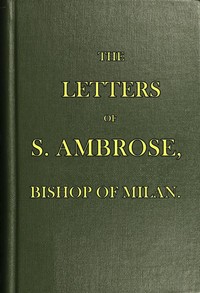
The catalog record for The Letters of S. Ambrose, Bishop of Milan — Inside the Classic provides practical reading context through 213,605 words, 15 hr 29 min estimated reading time, and 39 detected text sections.
The text analysis averages about 19.1 words per sentence, while the detected sections provide another way to judge how the source is divided.
Project Gutenberg metadata also associates the work with “Ambrose, Saint, Bishop of Milan, -397 -- Correspondence,” connecting these edition facts with the source record’s subject description.
Explore this collection
These alternatives are selected using recorded categories and estimated reading time.
About 558 minutes
Historical Psychological Social Fiction
128,150 recorded words. 371 minutes difference from this book's estimate.
View Gutenberg source #12515About 503 minutes
Historical Psychological Social Fiction
115,489 recorded words. 426 minutes difference from this book's estimate.
View Gutenberg source #637About 480 minutes
Historical Psychological Social Fiction
110,282 recorded words. 449 minutes difference from this book's estimate.
View Gutenberg source #43283Search stored excerpts and compare books → Choose by your preferences →
Choices use stored catalog measurements. Estimates vary with reading speed. A shared category is a catalog label, not a claim that two books have the same argument or literary quality.
Search reads excerpt text stored with this catalog and links to its associated Gutenberg record. The connection is stored in the site database; this tool does not recheck that every excerpt is word-for-word identical to that external record. Excerpt search does not cover every chapter and does not verify historical publication dates.
Catalog snapshot checked: 2026-09-25. Coverage: 92 public books, 92 available source excerpts.
Read the complete public-domain text at its original source.
Read on Project GutenbergThe volume opens not with Ambrose's own voice but with a Victorian editorial apparatus: a dedication to the Archbishop of Canterbury, a translator's note, and a notice explaining that the translation was 'made in the early days of the Library of the Fathers by a friend, now with God.' This framing immediately signals that the letters are mediated through a 19th-century Anglo-Catholic lens, where the translator's reverence for patristic authority is palpable. The first letter excerpt plunges into a defense of widowhood, where Ambrose marshals biblical precedents—Anna the prophetess, Paul's 'chastised body'—against unnamed opponents he labels 'Manichees.' His argumentative style is forensic: he poses rhetorical questions ('Did he then teach excess?'), cites scripture in rapid succession, and names specific condemned individuals (Jovinian, Auxentius). A first-time reader should note how Ambrose's pastoral concerns are inseparable from doctrinal polemic, and how the translation's notes and indices (mentioned in the front matter) will become essential for tracking his scriptural allusions and historical references.
Ambrose's letters are not private correspondence but public theological interventions. In the excerpt, he deploys a battery of rhetorical techniques: scriptural citation (Psalm 69, Jonah 3, Matthew 17), logical deduction ('If he is not believed so to have come, neither is He believed to have taken upon Him our flesh'), and ad hominem attack ('They have proved themselves to be truly Manichees'). He also uses collective witness, invoking 'our brethren and fellow-presbyters, Crescens, Leopardus, and Alexander' who helped expose the heretics. The letter concludes with a formal subscription list of bishops who concurred—Eventius, Maximus, Felix, Bassianus—underscoring that this is an official synodal condemnation, not a personal note. Readers should watch for how Ambrose shifts between intimate address ('Lord and brother most beloved') and institutional authority.
The 1881 translation, revised by Rev. H. Walford, bears marks of its era. Sentences are long and periodic: 'And fitting it is that these men should despise widowhood, which is wont to keep fasts, for they regret that they should have been mortified by these for any time.' The translator expands abbreviations for screen-readers and standardizes punctuation, as noted in the transcriber's preface. Scriptural references appear in sidenotes, and footnotes are accumulated at the end. This apparatus means that reading the letters involves constant cross-referencing—a practice the 19th-century editors assumed their audience would undertake. The text also preserves variant spellings ('shew' for 'show') and inconsistent hyphenation, which can momentarily disorient a modern reader but also authenticates the historical distance.
The central controversy in the provided excerpt concerns the body: Christ's incarnation, virginity, widowhood, and fasting. Ambrose insists that Christ 'was crucified for us in truth, He is in truth our Redeemer,' countering those who 'deny that Christ came in the flesh.' He links the denial of virgin birth to a rejection of real incarnation, which he equates with Manichaean dualism. The opponents—Jovinian and his associates—are accused of teaching 'excess' and despising fasting. Ambrose's defense of asceticism is grounded in Paul's example ('I chastised my body') and Old Testament precedents (Nineveh's deliverance). A reader unfamiliar with fourth-century heresies may need to consult the index or footnotes to grasp why these issues were so charged; the translation's apparatus is designed to supply that context.
The excerpts offer only fragments of a single letter, but they reveal patterns likely recurring throughout the collection: Ambrose's habit of weaving scripture into argument, his reliance on typology (Anna as a model widow), and his combative stance toward perceived error. The letter's structure—doctrinal exposition, refutation, appeal to authority, subscription—suggests a formal episcopal genre. Readers should note that the full collection spans 39 sections and over 200,000 words, covering topics from biblical exegesis to church discipline. The editorial note warns that 'scriptural references in sidenotes have not been corrected or changed,' implying possible inaccuracies. Approaching the letters as a first-time reader means accepting that the translation and apparatus are themselves historical artifacts, shaping how Ambrose's voice reaches us.
To read these letters attentively is to engage simultaneously with a fourth-century bishop's mind and a Victorian scholarly project. The translation's notes, indices, and textual notes are not optional extras but integral to understanding Ambrose's arguments and their context. A first reader might begin by sampling letters on different topics—virginity, the Trinity, church discipline—to gauge the range of his concerns, while always checking the footnotes for scriptural references and historical names. The letters reward patience: each citation is a thread leading into a larger tapestry of patristic thought.
The rain kept time with Ambrose’s careful arguments, his patient rulings on widowhood and fasting. I found myself wondering about the private lives behind such measured public words. Later, shuffling my shelves, I pulled down The Correspondence of Madame, Princess Palatine, Mother of the Regent; of Marie-Adélaïde de Savoie, Duchesse de Bourgogne; and of Madame de Maintenon, in Relation to — Themes and Context. Different century, but the same quiet tension between conviction and compromise.
Create a short personal record of your experience with this book.