About 186 minutes
Post-Prandial Philosophy — Inside the Classic
Science Fiction Utopias
42,587 recorded words. 1 minutes difference from this book's estimate.
View Gutenberg source #18788
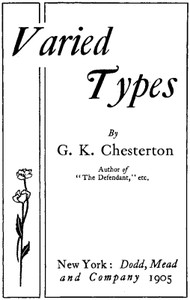
For Varied Types — Story, Setting & Ideas, the stored edition analysis reports 42,493 words, 3 hr 5 min estimated reading time, and 5 detected text sections.
The text analysis averages about 24.6 words per sentence, while the detected sections provide another way to judge how the source is divided.
Project Gutenberg metadata also associates the work with “Biography,” connecting these edition facts with the source record’s subject description.
Explore this collection
These alternatives are selected using recorded categories and estimated reading time.
About 186 minutes
Science Fiction Utopias
42,587 recorded words. 1 minutes difference from this book's estimate.
View Gutenberg source #18788About 157 minutes
Science Fiction Utopias
36,019 recorded words. 28 minutes difference from this book's estimate.
View Gutenberg source #1338About 122 minutes
Science Fiction Utopias
27,925 recorded words. 63 minutes difference from this book's estimate.
View Gutenberg source #16507Search stored excerpts and compare books → Choose by your preferences →
Choices use stored catalog measurements. Estimates vary with reading speed. A shared category is a catalog label, not a claim that two books have the same argument or literary quality.
Search reads excerpt text stored with this catalog and links to its associated Gutenberg record. The connection is stored in the site database; this tool does not recheck that every excerpt is word-for-word identical to that external record. Excerpt search does not cover every chapter and does not verify historical publication dates.
Catalog snapshot checked: 2026-09-25. Coverage: 92 public books, 92 available source excerpts.
Read the complete public-domain text at its original source.
Read on Project GutenbergChesterton opens his essay on Charlotte Brontë by dismissing the value of realistic biography, arguing that it fixates on details—class, address, ancestry—that are irrelevant to a writer's genius. He praises Brontë for showing that truth could be conveyed in a novel where no character has manners, a claim that sets the combative, aphoristic tone of the collection. Throughout Varied Types, Chesterton treats his subjects not as biographical summaries but as occasions for argument, often turning a received opinion on its head within a single paragraph.
Chesterton's characteristic method is the startling reversal. In the Brontë essay, he asserts that the most discussed Victorian authors are the least understood by biography, because their genius lies in asserting the unimportance of externals. He extends this technique to Tolstoy, where he flatly denies a claim about Christ's teaching, writing: 'I should very much like to know where in the whole of the New Testament the author finds this violent, unnatural, and immoral proposition.' The sentence is typical: it combines intellectual aggression with a colloquial rhythm, and it forces the reader to reconsider a premise that had been presented as self-evident.
The essays move at uneven speed. Chesterton often begins with a broad, almost leisurely observation—'Objection is often raised against realistic biography'—then tightens into a series of rapid, pointed clauses. In the Tolstoy section, he shifts from a general critique of pacifist theory to a detailed quarrel with a specific pamphlet, quoting and then dismantling its paraphrase of scripture. This change in pace, from philosophical overview to textual nitpicking, mirrors his argument that abstract systems founder on concrete misreadings. The effect is that of a debater who slows down only to deliver a knockout blow.
Chesterton's first-person plural is not the royal 'we' but a rhetorical device that draws the reader into complicity. In the Brontë essay, he writes: 'We are specifically told that there were certain persons whom He specially loved.' The 'we' assumes a shared knowledge of scripture and a shared impatience with sloppy interpretation. It also allows Chesterton to shift from exposition to rebuke without seeming merely personal. When he calls a Tolstoian paraphrase 'a simple and unadulterated untruth,' the bluntness is softened by the earlier 'we' that established a common ground. This voice gives the essays a conversational urgency even when the subject is centuries old.
Readers approaching Varied Types should expect not a series of balanced introductions but a sequence of provocations. Chesterton's pace is uneven, his judgments abrupt, and his willingness to generalize immense. The essays reward attention to how he builds and dismantles an argument in the same breath. Treat each piece as a performance of critical thinking rather than a reference work, and the collection coheres as a display of a single, insistent mind at work.
I found myself thinking of old afternoon light on paper, how Chesterton could turn a stray remark about Brontë into a quiet argument with the whole century. That same unhurried intimacy lives in Letters to an Unknown — Background and Themes, where the tone stays conversational yet carries a weight of unspoken questions. Strange, how two different books can leave the same feeling behind.
A brief reflection can help important ideas stay with you longer.