About 330 minutes
History of a literary radical, and other essays — Story, Setting & Ideas
Adventure Picaresque Fiction
75,776 recorded words. 33 minutes difference from this book's estimate.
View Gutenberg source #69426
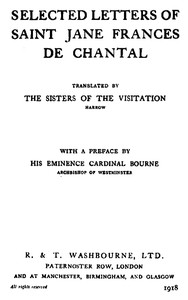
Before opening Selected Letters of Saint Jane Frances de Chantal — Text and Context, the edition data offers a quick orientation: 68,116 words, 4 hr 57 min estimated reading time, and 10 detected text sections.
The text analysis averages about 19.6 words per sentence, while the detected sections provide another way to judge how the source is divided.
Project Gutenberg metadata also associates the work with “Chantal, Jeanne-Françoise de, Saint, 1572-1641 -- Correspondence,” connecting these edition facts with the source record’s subject description.
Explore this collection
These alternatives are selected using recorded categories and estimated reading time.
About 330 minutes
Adventure Picaresque Fiction
75,776 recorded words. 33 minutes difference from this book's estimate.
View Gutenberg source #69426About 340 minutes
Adventure Picaresque Fiction
78,192 recorded words. 43 minutes difference from this book's estimate.
View Gutenberg source #2944About 342 minutes
Adventure Picaresque Fiction
78,651 recorded words. 45 minutes difference from this book's estimate.
View Gutenberg source #18135Search stored excerpts and compare books → Choose by your preferences →
Choices use stored catalog measurements. Estimates vary with reading speed. A shared category is a catalog label, not a claim that two books have the same argument or literary quality.
Search reads excerpt text stored with this catalog and links to its associated Gutenberg record. The connection is stored in the site database; this tool does not recheck that every excerpt is word-for-word identical to that external record. Excerpt search does not cover every chapter and does not verify historical publication dates.
Catalog snapshot checked: 2026-09-25. Coverage: 92 public books, 92 available source excerpts.
Read the complete public-domain text at its original source.
Read on Project GutenbergThe letters in this volume, translated by the Sisters of the Visitation at Harrow and introduced by Cardinal Bourne, offer a view of Saint Jane Frances de Chantal that differs from the finished portraits often found in biographies. The preface itself warns that biographers tend to omit the long toil behind the saintly image, and these letters supply some of that missing detail. Readers encounter a correspondent who mentions feeling cold and pressed for time, who advises a sister that her ailment is only nerves, and who frets over delayed news from Rome. Such remarks ground the spiritual content in the practical realities of daily life.
The letters show a writer who does not separate spiritual direction from mundane concerns. In one passage she excuses brevity because she is feeling the cold and pressed for time. In another she tells a sister to do everything to get well, for it is only your nerves. These are not the words of an abstracted mystic but of someone who acknowledges physical discomfort and psychological strain. The preface also notes her weariness over delay: still no news from Rome, and she urges a correspondent to push on the matter. The letters thus present a founder of a religious order who must manage practical obstacles while offering counsel on prayer and virtue.
A substantial portion of the excerpts concerns Saint Francis de Sales, Chantal's spiritual director and co-founder of the Visitation Order. She describes his prayer as impalpable and intangible, leaving only effects in the soul. She recounts that in his later years business left him little leisure for prayer, yet he said he did what is the same, holding himself always united to God. She attributes to him the maxim Ask for nothing, desire nothing, refuse nothing, and notes his complete self-control when subjected to rudeness. These details, drawn from her firsthand observation, give a concrete sense of his spiritual practice and temperament.
The volume is framed by a preface by Cardinal Bourne, who explicitly addresses the tendency to idealize saints and argues that letters reveal real character and spiritual growth. The translation is credited to the Visitation Nuns of Harrow, a community of the order Chantal founded. The excerpts include the nihil obstat and imprimatur, indicating ecclesiastical approval. The letters themselves are selected, not complete, and the preface draws on specific examples—the cold, the nerves, the delay—to illustrate their value. This editorial apparatus shapes how the letters are presented: as correctives to hagiography rather than as a comprehensive collection.
Readers approaching these letters should expect a blend of spiritual counsel and everyday practicalities. The correspondence does not offer a systematic treatise but rather a series of glimpses into the concerns of a 17th-century religious founder. The preface provides a useful lens for interpreting the letters as evidence of human struggle and growth. Those interested in the relationship between Chantal and Francis de Sales will find the passages describing his prayer and maxims particularly illuminating.
There is something grounding in reading Selected Letters of Saint Jane Frances de Chantal—her weariness, her small joys, her trust. It made me think of another correspondence, quieter in fame but equally human, where intellect meets tenderness across decades. The same unhurried honesty, the same gift of giving one’s whole attention to another person. Letters of Lord Acton to Mary, Daughter of the Right Hon. W. E. Gladstone — Context and Discussion holds that same warmth, I find.
Capture what you thought, learned, and would like to remember.