About 340 minutes
Essays — First Series — Reading Companion
Adventure Picaresque Fiction
78,192 recorded words. 10 minutes difference from this book's estimate.
View Gutenberg source #2944
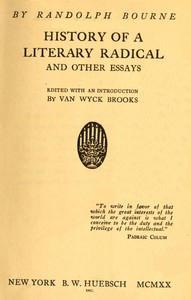
For History of a literary radical, and other essays — Story, Setting & Ideas, the stored edition analysis reports 75,776 words, 5 hr 30 min estimated reading time, and 26 detected text sections.
The text analysis averages about 22.1 words per sentence, while the detected sections provide another way to judge how the source is divided.
Project Gutenberg metadata also associates the work with “American essays -- 20th century,” connecting these edition facts with the source record’s subject description.
Explore this collection
These alternatives are selected using recorded categories and estimated reading time.
About 340 minutes
Adventure Picaresque Fiction
78,192 recorded words. 10 minutes difference from this book's estimate.
View Gutenberg source #2944About 342 minutes
Adventure Picaresque Fiction
78,651 recorded words. 12 minutes difference from this book's estimate.
View Gutenberg source #18135About 350 minutes
Adventure Picaresque Fiction
80,421 recorded words. 20 minutes difference from this book's estimate.
View Gutenberg source #48664Search stored excerpts and compare books → Choose by your preferences →
Choices use stored catalog measurements. Estimates vary with reading speed. A shared category is a catalog label, not a claim that two books have the same argument or literary quality.
Search reads excerpt text stored with this catalog and links to its associated Gutenberg record. The connection is stored in the site database; this tool does not recheck that every excerpt is word-for-word identical to that external record. Excerpt search does not cover every chapter and does not verify historical publication dates.
Catalog snapshot checked: 2026-09-25. Coverage: 92 public books, 92 available source excerpts.
Read the complete public-domain text at its original source.
Read on Project GutenbergRandolph Bourne, who died in 1918 at thirty-two, left behind essays that probe the habits of American intellectual exchange with unusual precision. In “On Discussion,” he dissects the gap between mere talk and genuine discussion, noting how participants often “use the same words, but they are not using the same meanings” and how unexamined philosophical assumptions—rigid platonists contending with pragmatists—derail conversation. This attention to unspoken frameworks recurs throughout the collection, which Van Wyck Brooks assembled from magazines including The Atlantic Monthly, The New Republic, and The Seven Arts.
In “On Discussion,” Bourne argues that Americans lack skill in “meeting each others’ minds” and that talk is left to “grow wild as a common flower.” He describes groups that meet from a “general craving for talk” rather than a shared problem, only to reveal “startling diversity” in mental equipment. The essay catalogues how ideals become ambiguous: one speaker means a “measuring-stick for human conduct,” another a “social goal.” Bourne’s diagnosis is structural, not merely anecdotal—he traces the failure to a refusal to treat talk as a deliberate technique. The piece exemplifies his method: close observation of social behavior used to expose deeper intellectual habits.
The title essay, “History of a Literary Radical,” appears to be a first-person narrative. The excerpt shows a speaker reflecting on a figure named Ernest, who “would not fit in easily to any smug conventional family life” and who “would not rest adopted until he was satisfied.” The narrator wonders whether he should have “called him back,” suggesting a meditation on affinity and independence. Because only a fragment is provided, the full arc of this essay remains unclear, but the voice is markedly different from the analytical tone of “On Discussion”—more personal, tentative, and speculative. The contrast hints at Bourne’s range as an essayist.
Van Wyck Brooks’s introduction supplies biographical context: Bourne was born in 1886, attended Columbia, held a Gilder Fellowship, and wrote for several prominent magazines before his early death. Brooks notes that Bourne “had not quite found himself” at thirty-two, a judgment that colors how the essays are presented—as the work of a mind still developing. The collection itself, published posthumously in 1920, includes pieces from 1911 onward. Brooks’s framing invites readers to see the essays as fragments of an unfinished project, though the excerpts available here do not reveal whether Bourne’s novel or political study was ever completed.
Readers approaching this collection should attend to the interplay between Bourne’s analytical essays and his more personal pieces. The excerpts suggest a writer who scrutinized intellectual community while also dramatizing his own place within it. Because only a portion of the text is available, the coherence of the volume as a whole—and the extent to which Brooks’s editorial hand shaped it—remains an open question. Bourne’s voice, however, is distinct: skeptical, precise, and alert to the unspoken rules that govern how Americans think together.
Bourne’s essays made me linger on how solitude shapes a writer’s convictions, that quiet friction between inner honesty and the pull of the group. It reminded me of another collection I once leafed through, where similar themes unfurl with a gentler, more contemplative hand: Lectures and Essays — Key Ideas to Explore. That book felt like a candle left burning in an empty room, waiting.
Create a short personal record of your experience with this book.