
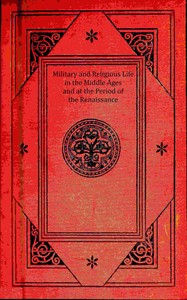
Military and religious life in the Middle Ages and at the period of the…
P.L. Jacob's Military and Religious Life in the Middle Ages feels less like a textbook and more like you sneaked into a time-traveling historian's notebook. It’s a world of mud, prayer, steel, and stone—brought to vivid life.
The Story
There's no single plot here, but a layered deep dive into two forces that defined an age. First, the military life: knights, castles, sieges, and the brutal code of chivalry. Jacob shows you what it meant to be a professional killer in a suit of armor, from training to combat. Then, the flip side—the religious life: monks, cathedrals, pilgrimages, and the vast power of the Church. Both worlds preached faith and force, often in the same breath. Jacob traces how kings managed armies in peacetime, how peasants paid for wars with their crops, and how monasteries became both libraries and fortresses. Conflict is everywhere—city vs. country, piety vs. politics, rich clergy vs. poor warriors.
Why You Should Read It
Reading this book gave me that 'wait, what?' feeling on almost every page. Let me give you a personal example: Did you know that a medieval knight might end up broke from the cost of his gear? Or that many cathedrals were packed, smelled awful, and were basically designed to look like heaven? Jacob takes you there without bogging you down with dates. I found myself arguing in my head with the author—especially when he talks about 'barbaric' customs. Look, it's old-fashioned in places (it's from the 1800s!), and his prejudices peek through. But that honesty makes it even more engaging because it’s one guy trying to make sense of a busy, harsh past. He skips the boring charts and gives you the good stuff: how you trained for a battle, what you ate on a Friday in Lent, how a war horse cost more than a house. For the everyday person, this isn't a snooze—it's a revelation.
Final Verdict
Perfect for history buffs (not just experts), adventure lovers, and anyone who's watched 'The Crown' and wondered how that world was born. Caveat: the writing is shaped by old-fashioned views that might not sit well with modern readers (lower-key sexism, for one). But for the passionate reader, that’s part of the conversation. If you doubt that a musty 1800s history book could keep your attention? Grab a copy and prepare to have your week blown away.
This content is free to share and distribute. Access is open to everyone around the world.
Kimberly Miller
8 months agoFrom a researcher's perspective, the way the author breaks down the core concepts is remarkably clear. A rare gem in a sea of mediocre content.
Michael Smith
7 months agoThe methodology used in this work is academically sound.
Thomas Anderson
1 year agoIt’s refreshing to see such a high standard of digital publishing.




Mary Thomas
2 months agoI've been looking for a reliable source on this topic, and the wealth of information provided exceeds the average market standard. This adds significant depth to my understanding of the field.