About 185 minutes
Interludes being Two Essays, a Story, and Some Verses — A Reader’s Guide
Fantasy Juvenile Worlds
42,374 recorded words. 10 minutes difference from this book's estimate.
View Gutenberg source #17065
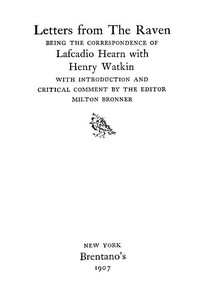
The source record for Letters from the Raven: Correspondence of L. Hearn with Henry Watkin — Story, Setting & Ideas measures this digital text at 40,152 words, 2 hr 55 min estimated reading time, and 4 detected text sections.
The text analysis averages about 21.2 words per sentence, while the detected sections provide another way to judge how the source is divided.
Project Gutenberg metadata also associates the work with “Authors, American -- 19th century -- Correspondence,” connecting these edition facts with the source record’s subject description.
Explore this collection
These alternatives are selected using recorded categories and estimated reading time.
About 185 minutes
Fantasy Juvenile Worlds
42,374 recorded words. 10 minutes difference from this book's estimate.
View Gutenberg source #17065About 188 minutes
Fantasy Juvenile Worlds
43,093 recorded words. 13 minutes difference from this book's estimate.
View Gutenberg source #17584About 137 minutes
Fantasy Juvenile Worlds
31,282 recorded words. 38 minutes difference from this book's estimate.
View Gutenberg source #16706Search stored excerpts and compare books → Choose by your preferences →
Choices use stored catalog measurements. Estimates vary with reading speed. A shared category is a catalog label, not a claim that two books have the same argument or literary quality.
Search reads excerpt text stored with this catalog and links to its associated Gutenberg record. The connection is stored in the site database; this tool does not recheck that every excerpt is word-for-word identical to that external record. Excerpt search does not cover every chapter and does not verify historical publication dates.
Catalog snapshot checked: 2026-09-25. Coverage: 92 public books, 92 available source excerpts.
Read the complete public-domain text at its original source.
Read on Project GutenbergEditor Milton Bronner frames this collection not as a generic reading guide but as a deliberate effort to let Hearn speak for himself, providing only enough commentary to clarify the author's own words. The letters, written during 1876 when Hearn was a twenty-six-year-old reporter for the Cincinnati Commercial, capture a pivotal year marked by political conventions and the Centennial Exposition. Bronner emphasizes that Hearn wrote to Henry Watkin as his dearest friend, and that these letters contain facts essential for any future biographer.
Bronner repeatedly draws attention to Hearn's severe visual impairment: he had only a "pearly vision of the world" and faced the constant threat of blindness. The mere physical act of writing a single letter demanded hours of labor. Yet, paradoxically, Hearn's published works revel in vivid color descriptions, a feat Bronner calls one of his secrets. The editor marvels at how Hearn managed to perceive and render the visual world so richly when he saw it "as through a ghostly vapor." This tension between physical limitation and artistic output is a recurring motif in the introduction.
Bronner paints Hearn as a deeply solitary figure, uncomfortable in social settings and perpetually guarded. Hearn himself wrote of life as "a curious carnival, in which one must be careful to keep on the mask." His chief friend was Henry Watkin; there is no record of friendships with young women. The editor contrasts Hearn with Prosper Mérimée: whereas Mérimée's famous letters to an unknown woman broke through his usual impersonality, Hearn's letters show him always holding back, offering "second thoughts" rather than spontaneous warmth. The unknown woman in Hearn's life—older, cultured, and wealthy—reportedly resented this restraint.
Bronner explicitly states that these letters were gathered in hopes of compiling a "Life and Letters of Hearn," a project that never materialized. He acknowledges that some sections were written at widely separated intervals and may contain repetitions, but he believes the material offers a better understanding of the author. The editor's approach is to minimize his own commentary and let the correspondence stand as the primary source. The result is a volume that feels less like a polished biography and more like a trove of raw evidence, preserving Hearn's voice and moods as they were confided to his closest friend.
Readers approaching this collection should expect an intimate, fragmentary portrait rather than a continuous narrative. Bronner's editorial hand is light, so the letters carry the weight of revelation. Pay attention to Hearn's recurring themes—his visual impairment, his social unease, his cautious self-revelation—as they surface across different letters. The gaps and repetitions are part of the record, reminding us that this is a work in progress toward a biography that never was.
Reading those letters, I kept thinking how Hearn saw the world through a veil, half-blind yet noticing everything. That same delicate attention to what fades haunts Sketches from Memory (From: "The Doliver Romance and Other Pieces: Tales and Sketches") — Inside the Classic—a quiet holding onto moments before they slip, much like his old correspondence.
Use these questions to collect your thoughts before moving on.