
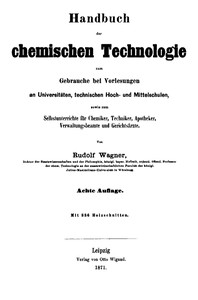
Handbuch der chemischen Technologie by Johannes Rudolf Wagner
Forget what you think you know about old technical manuals. Johannes Rudolf Wagner's Handbuch der chemischen Technologie is less a simple reference book and more a panoramic tour of the 19th century's industrial backbone. Published in multiple editions, the 1875 version captures a world on the cusp of modernity, documenting the chemical processes that built everyday life.
The Story
There's no traditional plot, but there is a compelling narrative: the story of human ingenuity applied to raw materials. Wagner systematically walks through the technology of his time. One chapter might detail the intricate process of extracting sugar from beets. The next explains the manufacture of pigments for paints, the production of glass, or the brewing of beer. It's a vast catalog of 'how-to,' covering everything from metallurgy and dye-making to the creation of fertilizers and soaps. The 'story' is the journey from natural resource to finished, useful product, told with the precision of a scientist and the thoroughness of a master craftsman.
Why You Should Read It
This book is a revelation for anyone interested in history, science, or just how stuff works. Its value isn't in providing usable formulas for today (safety standards have thankfully evolved!), but in offering a direct line to the thinking of the past. You see the roots of our chemical industry. You gain a profound appreciation for the complexity of things we now take for granted. Reading about the multi-step process to create a simple bar of soap or a pane of window glass makes you realize how resourceful and clever our ancestors were. It turns the mundane objects of the Victorian world into minor miracles of applied knowledge.
Final Verdict
This is not a cover-to-cover read for everyone. It's a specialist's treasure trove and a history lover's secret weapon. Perfect for historical fiction writers needing authentic period detail, STEAM educators looking for primary sources on the Industrial Revolution, or any curious reader who enjoys peering under the hood of bygone eras. Approach it like a museum you can browse—dip into chapters that catch your eye. You'll come away with a grounded, tangible sense of how the physical world of the 1800s was literally put together.
The copyright for this book has expired, making it public property. It is available for public use and education.
David Martin
4 months agoThe digital index is well-organized, making research much faster.
William Lee
5 months agoI was skeptical about the depth of this book at first, but the practical checklists included are a great touch for real-world use. The insights gained here are worth every minute of reading.
Patricia Davis
1 year agoI've gone through the entire material twice now, and the breakdown of complex theories into digestible segments is masterfully done. Simple, effective, and authoritative – what else could you ask for?





Richard Jackson
1 year agoThis work demonstrates a clear mastery of contemporary theories.