About 330 minutes
Excursions — Themes and Context
Science Fiction Utopias
75,839 recorded words. 29 minutes difference from this book's estimate.
View Gutenberg source #9846
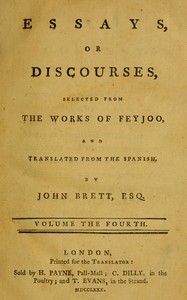
This digital edition of Essays, or discourses, vol. 4 (of 4) — Background and Themes is described by source-level measurements including 82,441 words, 5 hr 59 min estimated reading time, and 14 detected text sections.
The text analysis averages about 43.4 words per sentence, while the detected sections provide another way to judge how the source is divided.
Project Gutenberg metadata also associates the work with “Spanish essays -- Translations into English,” connecting these edition facts with the source record’s subject description.
Explore this collection
These alternatives are selected using recorded categories and estimated reading time.
About 330 minutes
Science Fiction Utopias
75,839 recorded words. 29 minutes difference from this book's estimate.
View Gutenberg source #9846About 329 minutes
Science Fiction Utopias
75,494 recorded words. 30 minutes difference from this book's estimate.
View Gutenberg source #7257About 406 minutes
Science Fiction Utopias
93,252 recorded words. 47 minutes difference from this book's estimate.
View Gutenberg source #577Search stored excerpts and compare books → Choose by your preferences →
Choices use stored catalog measurements. Estimates vary with reading speed. A shared category is a catalog label, not a claim that two books have the same argument or literary quality.
Search reads excerpt text stored with this catalog and links to its associated Gutenberg record. The connection is stored in the site database; this tool does not recheck that every excerpt is word-for-word identical to that external record. Excerpt search does not cover every chapter and does not verify historical publication dates.
Catalog snapshot checked: 2026-09-25. Coverage: 92 public books, 92 available source excerpts.
Read the complete public-domain text at its original source.
Read on Project GutenbergBenito Jerónimo Feijoo opens his fourth volume of essays by redefining the term "paradox" itself: not as a false proposition, but as one that appears improbable to the general eye yet may prove true under strict examination. This framing sets the tone for a work that consistently questions received opinion, whether in natural philosophy or moral governance. Translator John Brett renders Feijoo's arguments in a measured, eighteenth-century English prose that preserves the author's habit of addressing the reader directly and marshaling evidence from both classical authorities and contemporary experiments.
Feijoo begins by distinguishing his use of "paradox" from mere falsehood, insisting that the term describes propositions that are initially incredible but can be shown true or probable through careful reasoning. He immediately applies this method to elemental fire, arguing that it is not hot in the highest degree—a claim that contradicts the "vulgar physics" of his time. His evidence is concrete: the heat of the sun concentrated through a burning glass surpasses any effect of elemental fire. This opening move establishes a pattern of argument that recurs throughout the volume: identify a widely held belief, subject it to logical and empirical scrutiny, and propose a counterintuitive alternative.
In the section on moral and political paradoxes, Feijoo turns his skeptical lens on acts commonly praised as magnanimous. He recounts an anecdote of a king who, upon hearing a subject wish for a sum of money, immediately gives it to him. Where others see generosity, Feijoo sees weakness and a want of reflection—a rash impulse driven by vanity rather than true virtue. He then poses a pointed question: if making one man happy is glorious, is it not far more glorious to make a whole nation so? This rhetorical strategy, moving from a specific example to a general principle, characterizes his method throughout the political essays.
Feijoo develops one of his most striking analogies when discussing royal finance: the treasury is like the ocean, receiving contributions from all the kingdom as the ocean receives waters from every stream. Just as the ocean must return that water in refreshing rains to fertilize the earth, so must the treasury redistribute wealth to benefit the whole nation, not merely a few individuals. The analogy is extended with precision—if the ocean only watered a few districts, the rest would become barren; similarly, if a prince hoards or squanders public money on favorites, the majority of subjects suffer. This image recurs as a touchstone for Feijoo's economic arguments.
Feijoo supports his political arguments with specific sources, notably the letters of Father Contanein describing the emperor of China at the beginning of the eighteenth century. He cites the eighteenth volume of Edifying and Curious Letters of Foreign Missionaries and an extract in the Memoirs of Trevoux of 1728. This reliance on contemporary travel and missionary accounts is characteristic of Feijoo's method: he draws on a wide range of authorities, from classical philosophy to recent Jesuit reports, to ground his paradoxes in observable reality. The Chinese emperor is presented as a model of a ruler who labored incessantly to promote the good of his subjects—a contrast to the vain king of the earlier anecdote.
Readers approaching this volume should attend to Feijoo's habit of questioning not just received opinions but the very terms in which they are expressed. His paradoxes are not mere provocations; they are invitations to examine evidence and reasoning. The translator's preface and notes, if present, may clarify eighteenth-century references, but the essays themselves reward careful reading of their analogies and rhetorical structures.
There’s something about Feijoo’s paradoxes that stays with you—not as answers, but as quiet questions. I felt that same lingering weight reading The Works of Samuel Johnson, in Sixteen Volumes. Volume 04 — Reading Notes. His moral observations sit beside you like an old friend’s hand on your shoulder, unhurried, patient, and oddly comforting in their honesty.
Capture what you thought, learned, and would like to remember.