
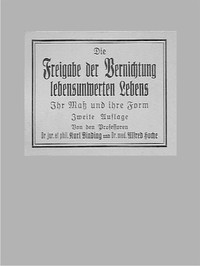
Die Freigabe der Vernichtung lebensunwerten Lebens by Karl Binding and Alfred Hoche
This isn't a book with characters or a plot in the traditional sense. It's a short, dense academic work published in 1920 by Karl Binding, a respected legal scholar, and Alfred Hoche, a prominent psychiatrist. Together, they make a case that has nothing to do with medicine or care, and everything to do with economics and a twisted view of human value.
The Story
Binding and Hoche lay out their argument step-by-step. First, they invent the term 'lebensunwertes Leben'—'life unworthy of life.' They apply this label to people with severe, incurable mental disabilities, calling them 'mentally dead' and 'human ballast.' Then, they argue from a legal and 'social hygiene' perspective. They say these lives are a financial drain on families and the state, and that ending them would be a 'healing treatment' for society. They propose a system where a committee would review cases and grant 'permission' for this destruction, framing it not as murder, but as a merciful, logical act. The 'story' here is the construction of an idea, brick by bureaucratic brick, that removes all humanity from its subjects.
Why You Should Read It
You should read this not to agree with it, but to understand a dangerous mode of thinking. Its power lies in its tone. There's no raging hatred here—just cool, detached analysis. That's what makes it so chilling. You see how prejudice dresses up in academic language, how compassion is redefined as elimination. Reading it, you can trace a direct line from this text to the T4 euthanasia program that killed over 70,000 disabled Germans before the Holocaust even began. It forces you to ask hard questions about how we value human life today, and what happens when we start calculating a person's worth based on utility or cost.
Final Verdict
This is essential, if deeply unsettling, reading for anyone interested in 20th-century history, the roots of Nazi ideology, or medical ethics. It's not for casual enjoyment; it's a historical document that demands reflection. If you've read books about the Holocaust and wondered 'how could people think that way?', this text provides a clear, frightening answer. It shows that the road to atrocity is often paved with polished arguments from respected authorities. Approach it as a crucial warning from the past, a reminder to always question who gets to decide what makes a life 'worthy.'
This masterpiece is free from copyright limitations. Feel free to use it for personal or commercial purposes.
Thomas Thomas
10 months agoAfter spending a few days with this digital edition, the step-by-step breakdown of the methodology is extremely helpful for students. If you want to master this topic, start right here.
Margaret Brown
7 months agoOne of the most comprehensive guides I've read this year.
Elizabeth Davis
7 months agoUnlike many other resources I've purchased before, the formatting on mobile devices is surprisingly crisp and clear. This is a solid reference for both beginners and experts.
Patricia Young
1 year agoAfter finishing this book, the author's voice is distinct and makes complex topics easy to digest. Absolutely essential reading.

Ashley Gonzalez
3 months agoI decided to give this a try based on a colleague's recommendation, the cross-referencing of different chapters makes it a great study tool. A refreshing and intellectually stimulating read.