
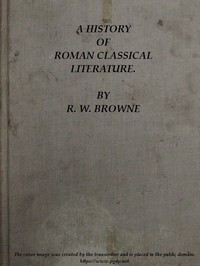
A History of Roman Classical Literature. by R. W. Browne
Let's be clear: this isn't a novel with a plot. But it does have a story—the story of an entire civilization finding its voice. R.W. Browne, writing in the mid-1800s, guides us through the rise, golden age, and slow transformation of Roman writing, from its rough beginnings to its polished peak.
The Story
Browne starts at the very beginning, when Roman literature was basically borrowing from the Greeks. He walks us through how they made it their own. We see the early playwrights like Plautus, whose comedies were the blockbuster sitcoms of their day. Then we hit the big names of the Republic: Cicero, whose speeches were political weapons, and Lucretius, who tried to explain the universe through poetry. The heart of the book is the Augustan Age—the 'Golden Age' with Virgil, Horace, and Ovid. Browne shows how their work wasn't just art; it was part of building a new national identity under Emperor Augustus. Finally, he follows the thread into the Silver Age and beyond, looking at historians like Tacitus and satirists like Juvenal, who wrote with a sharper, more cynical edge as the empire's politics grew darker.
Why You Should Read It
What makes this old book special is Browne's voice. He has clear favorites (his admiration for Virgil is palpable) and isn't afraid to call a later writer's work 'forced' or 'less inspired.' It feels like getting a guided tour from someone who genuinely loves the subject. He constantly links the literature to the life of Rome—how conquest, civil war, and peace shaped what was written. You finish understanding that Cicero's speeches were high-stakes drama, Ovid's exile was a brutal political lesson, and satire was a dangerous way to critique power. It makes the ancient world feel immediate and human.
Final Verdict
This is the perfect book for a curious reader who wants to go deeper than a Wikipedia list. It's for anyone who enjoyed novels like 'I, Claudius' and wants to know about the real literary world behind the drama. It's also a great companion for a student taking a classics course, providing a clear, narrative overview that many modern textbooks lack. Fair warning: it's a 19th-century book, so some references might feel dated, and its perspective is solely on the 'great men' of literature. But if you want an engaging, opinionated, and wonderfully clear foundation to understand why Rome's words have lasted as long as its roads, Browne's history is a fantastic place to start.
This book is widely considered to be in the public domain. Preserving history for future generations.
George Smith
3 weeks agoOne of the most comprehensive guides I've read this year.
Margaret Thompson
8 months agoRight from the opening paragraph, the author manages to bridge the gap between theory and practice effectively. Finally, a source that prioritizes accuracy over hype.
Linda Wilson
1 year agoComparing this to other titles in the same genre, the author’s unique perspective adds a fresh layer to the discussion. I'll be citing this in my upcoming project.
Barbara Wilson
6 months agoRight from the opening paragraph, the emphasis on ethics and sustainability within the topic is commendable. If you want to master this topic, start right here.






David Lopez
9 months agoWhile browsing through various academic sources, the author manages to bridge the gap between theory and practice effectively. I'll be citing this in my upcoming project.