About 448 minutes
The Unseen World, and Other Essays — Inside the Classic
Fantasy Juvenile Worlds
102,829 recorded words. 1056 minutes difference from this book's estimate.
View Gutenberg source #1486
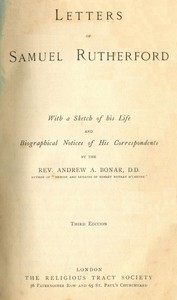
The catalog record for Letters of Samuel Rutherford (Third Edition) — Themes and Context provides practical reading context through 345,707 words, 25 hr 4 min estimated reading time, and 49 detected text sections.
The text analysis averages about 18.4 words per sentence, while the detected sections provide another way to judge how the source is divided.
Project Gutenberg metadata also associates the work with “Rutherford, Samuel, 1600?-1661 -- Correspondence,” connecting these edition facts with the source record’s subject description.
Explore this collection
These alternatives are selected using recorded categories and estimated reading time.
About 448 minutes
Fantasy Juvenile Worlds
102,829 recorded words. 1056 minutes difference from this book's estimate.
View Gutenberg source #1486About 398 minutes
Fantasy Juvenile Worlds
91,374 recorded words. 1106 minutes difference from this book's estimate.
View Gutenberg source #6170About 387 minutes
Fantasy Juvenile Worlds
88,949 recorded words. 1117 minutes difference from this book's estimate.
View Gutenberg source #38280Search stored excerpts and compare books → Choose by your preferences →
Choices use stored catalog measurements. Estimates vary with reading speed. A shared category is a catalog label, not a claim that two books have the same argument or literary quality.
Search reads excerpt text stored with this catalog and links to its associated Gutenberg record. The connection is stored in the site database; this tool does not recheck that every excerpt is word-for-word identical to that external record. Excerpt search does not cover every chapter and does not verify historical publication dates.
Catalog snapshot checked: 2026-09-25. Coverage: 92 public books, 92 available source excerpts.
Read the complete public-domain text at its original source.
Read on Project GutenbergSamuel Rutherford's letters, collected in this third edition edited by Andrew A. Bonar, are structured as a chronological sequence of 365 pieces, each addressed to a specific correspondent and framed by the circumstances of the writer's life. The letters repeatedly shift between two poles: the immediate, often painful, setting of exile or imprisonment, and the anticipated arrival of a divine 'summer day.' This movement is not merely thematic but structural, as each letter typically opens with a concrete situation—illness, death, political turmoil—and then pivots to a sustained meditation on eternal realities.
Bonar's editorial apparatus, including biographical notices of correspondents and a glossary of Scottish terms, underscores the historical particularity of each letter. Yet the letters themselves resist being read as mere historical documents; their recurring images of travel, waiting, and release invite the reader to trace a consistent spiritual geography across the collection.
Rutherford frequently identifies himself as a 'prisoner of hope,' a phrase that condenses his characteristic stance. In letter CXCVI, he writes from Aberdeen in 1637, describing himself as 'still a prisoner of hope' who waits 'with submission, till the Lord's morning sky break.' The posture is both literal—Rutherford was banished to Aberdeen for his nonconformity—and metaphorical: the prison becomes a vantage point from which to look toward deliverance. This dual perspective recurs throughout the collection, as the writer addresses correspondents from various locations, always framing his physical confinement as a temporary condition within a larger divine timetable.
The letters often exhort readers to 'make windows in our prison,' an image that transforms the cell into a lookout. This is not escapism but a disciplined orientation: the prisoner is to 'look out to God and our country, heaven.' The structure of individual letters mirrors this movement, beginning with the 'knotty and thorny life' and ending with a prayer for Christ's coming.
Rutherford's letters are saturated with the language of journey. He describes the world as a 'little clay inn' where believers are 'neither well summered nor well wintered,' and urges his correspondents to be 'ready for shipping, against the time our Lord's wind and tide call for us.' The metaphor of travel is not merely decorative; it structures the argument of many letters. In one passage, he compares the believer's relation to the world to a traveler's relation to a drink of water: 'ten miles' journey maketh that drink to him as nothing.'
This recurring image serves to relativize earthly attachments. The letters repeatedly contrast the 'clay inn' with the believer's true home, and the journey itself is presented as a process of weaning from the world. The editor's inclusion of topographical notes reinforces the literal geography behind these metaphors, grounding the spiritual travel in Rutherford's actual movements between Anwoth, Aberdeen, and other locations.
A consistent structural pattern in the letters is the alternation between affliction and comfort. Rutherford does not dwell on suffering for its own sake; rather, each trial is immediately paired with a divine response. In a letter to Lady Kenmure on the death of her infant daughter, he writes that 'tribulation' is 'the portion of God's people, and intended to wean them from the World.' The movement is from loss to resignation, from pain to purpose.
This rhythm is evident even in the letter headings provided by Bonar, which often pair a specific circumstance with a theological theme: 'Acquiescence in God's Purpose—Faith in exercise—Encouragement in view of Sickness and Death.' The letters themselves follow this pattern, moving from the particular grief to a broader perspective. Rutherford's voice is consistent in its refusal to minimize suffering, yet it always turns toward hope, as when he writes of 'the last thief' death that comes 'without din or noise of feet' and then immediately urges the reader to 'seek to be found of your Lord in peace.'
Throughout the letters, Rutherford employs a cluster of images related to binding, imprisonment, and liberation. He speaks of being 'fettered' and of 'irons,' but also of the soul being 'mastered and subdued to Christ's love.' The paradox of freedom through bondage is central: the believer is to 'suffer ourselves to be mastered' by Christ, so that Christ becomes 'our all things' and all else 'nothings.'
This imagery extends to the natural world. In letter CXCVI, Rutherford imagines 'every day a little stone in the prison-walls were broken,' giving assurance to the 'chained prisoner.' The breaking of stones is a slow, incremental process, mirroring the gradual nature of spiritual growth. The letters themselves function as such incremental acts of breaking, each one chipping away at the reader's attachment to the world. Bonar's chronological arrangement allows the reader to observe how these images recur and develop over time, creating a cohesive symbolic language that spans the entire collection.
Readers approaching this edition will find that the letters reward attention to their recurring imagery and structural patterns. The chronological ordering, combined with Bonar's biographical notes, allows one to trace how Rutherford's circumstances shaped his language without reducing the letters to mere autobiography. The collection is best read not as a single argument but as a series of variations on a few core images—prison, travel, waiting, release—each letter offering a fresh configuration of the same spiritual geography.
That rainy afternoon, reading Letters of Samuel Rutherford, I kept returning to his quiet waiting between suffering and hope, unsure why it felt so familiar. Later, setting it aside, I somehow picked up The Complete Essays of John Galsworthy — Story, Setting & Ideas. There was the same unhurried patience, though rooted in lawns and river walks, not prison walls. Both lingered in the space between what is and what might be.
A brief reflection can help important ideas stay with you longer.