
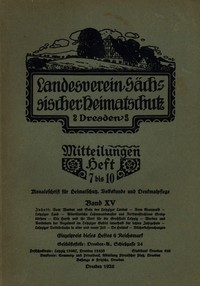
Landesverein Sächsischer Heimatschutz — Mitteilungen Band XV, Heft 7–10…
Let's be clear from the start: this is not a bedtime story. 'Landesverein Sächsischer Heimatschutz — Mitteilungen Band XV, Heft 7–10…' is a bound volume of periodical issues from a Saxon heritage protection society, likely published in the early 1900s. The author is listed as 'Unknown' because it's a compilation of reports, essays, and meeting notes from various members.
The Story
There's no narrative arc in the traditional sense. Instead, you're reading the raw minutes of a club dedicated to 'Heimatschutz'—a German concept meaning the protection of homeland and local identity. The 'plot' unfolds in discussions about preserving historic buildings, recording regional dialects, cataloging folk art, and debating new construction projects. It's the story of a group of people looking at their changing world—industrialization, modernization—and saying, 'Wait, let's not lose this.' You'll find detailed descriptions of village layouts, arguments about architectural styles, and lists of culturally significant sites. The drama is in the details and the palpable sense of urgency these anonymous writers felt.
Why You Should Read It
I found this fascinating because it strips history down to its grassroots. This isn't about kings and battles; it's about someone's favorite tree in a town square or the proper thatching technique for a roof. Reading it feels intimate. You get a direct line to the concerns of everyday people a hundred years ago. Their passion is contagious. It makes you look at your own surroundings differently. What in my town would I fight to protect? The book is also a powerful reminder of how much history is collected and saved by volunteers and enthusiasts, not just big institutions. The 'Unknown' authorship adds to this—it's about the collective effort, not individual fame.
Final Verdict
This is a super niche read, but a rewarding one. It's perfect for history buffs, especially those interested in social history, preservation, or German regional culture. It's also great for writers or artists seeking authentic period detail or a unique primary source. You need some patience and curiosity—this isn't for someone wanting a fast-paced novel. But if you enjoy piecing together a picture of the past from fragments, or if you've ever been a member of a local historical society, you'll feel right at home. Think of it as an archaeological dig in book form.
There are no legal restrictions on this material. It is available for public use and education.
Jennifer Miller
1 year agoGiven the current trends in this field, the transition between theoretical knowledge and practical application is seamless. A mandatory read for anyone in this industry.
Thomas Thompson
6 months agoWhile browsing through various academic sources, the clarity of the writing makes even the most dense sections readable. A trustworthy resource that I'll keep in my digital library.
Jessica Gonzalez
2 years agoI wanted to compare this perspective with traditional views, the chapter on advanced strategies offers insights I haven't seen elsewhere. This is a solid reference for both beginners and experts.
John Thomas
6 months agoAfter a thorough walkthrough of the table of contents, the clarity of the writing makes even the most dense sections readable. The price-to-value ratio here is simply unbeatable.








Susan Harris
4 months agoLooking at the bibliography alone, the historical context mentioned in the early chapters is quite enlightening. An excellent example of how quality digital books should be formatted.