About 452 minutes
Correspondence of Wagner and Liszt — Volume 1 — A Closer Reading
Adventure Picaresque Fiction
103,751 recorded words. 3 minutes difference from this book's estimate.
View Gutenberg source #3835
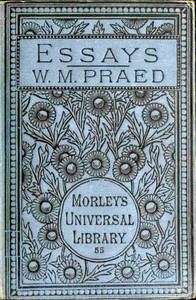
For Essays — Context and Discussion, the stored edition analysis reports 103,121 words, 7 hr 29 min estimated reading time, and 12 detected text sections.
The text analysis averages about 21.8 words per sentence, while the detected sections provide another way to judge how the source is divided.
Project Gutenberg metadata also associates the work with “English essays -- 19th century,” connecting these edition facts with the source record’s subject description.
Explore this collection
These alternatives are selected using recorded categories and estimated reading time.
About 452 minutes
Adventure Picaresque Fiction
103,751 recorded words. 3 minutes difference from this book's estimate.
View Gutenberg source #3835About 413 minutes
Adventure Picaresque Fiction
94,952 recorded words. 36 minutes difference from this book's estimate.
View Gutenberg source #38214About 506 minutes
Adventure Picaresque Fiction
116,274 recorded words. 57 minutes difference from this book's estimate.
View Gutenberg source #48035Search stored excerpts and compare books → Choose by your preferences →
Choices use stored catalog measurements. Estimates vary with reading speed. A shared category is a catalog label, not a claim that two books have the same argument or literary quality.
Search reads excerpt text stored with this catalog and links to its associated Gutenberg record. The connection is stored in the site database; this tool does not recheck that every excerpt is word-for-word identical to that external record. Excerpt search does not cover every chapter and does not verify historical publication dates.
Catalog snapshot checked: 2026-09-25. Coverage: 92 public books, 92 available source excerpts.
Read the complete public-domain text at its original source.
Read on Project GutenbergWinthrop Mackworth Praed's essays, collected here by Sir George Young, move with a restless energy between comic set-pieces and quieter autobiographical sketches. The opening contents list alone signals a mind fond of paradox and wordplay: Rhyme and Reason sits beside On the Practical Bathos, while Yes and No and Thoughts on the Words 'Turn Out' suggest a writer who treats language as both toy and tool. The volume's structure—forty-odd pieces arranged without obvious thematic grouping—invites the reader to dip in at random, much as one might browse a club library.
Throughout the excerpts, Praed repeatedly returns to certain images that anchor his flights of fancy. In Leonora, he imagines building a temple in Fancy where 'no two flowers shall wear the same hue' and streams change course hourly—a landscape of deliberate instability. This same restlessness appears in Old Boots, where a pair of boots becomes a vehicle for memory: they 'withstood all the malice of Devonshire paviours,' carried the author through a deserted childhood home, and 'tottered upon the perilous summit of the Ness.' The boots are not just objects but witnesses, their 'heavy clanging sound' echoing through empty rooms. Praed often moves from the concrete to the fanciful within a single paragraph, as when the solid leather sole 'resembled a quarto'—a joke that ties footwear to bookmaking. These shifts in scale and setting, from a boot to a temple of Fancy, create a rhythm of contraction and expansion that defines the collection's voice.
Several essays treat social gatherings as theatrical performances. Golightly's Essay on Blues dissects the 'conversazione' of Lady Dabble, where 'criticism and tea are poured out together' and 'sweet sugar and sweeter sonnets melt in delicious unison.' The piece categorises Blues by shade—Light, Dark, Sky—each with a distinct manner of pedantry. Emilia the Light Blue 'talks learnedly, and amuses you,' while Sophia the Dark Blue 'talks learnedly, and puzzles you.' This taxonomy extends to physical description: Eva the Sky-Blue has 'a pretty pair of blue eyes, a finely polished neck, an enchanting white arm, and a voice ... never heard but in a whisper, an aria, or a sigh.' The essay ends with a punning nickname, 'Blue Ruin,' that undercuts the romantic portrait. Praed's eye for social performance is equally sharp in Politeness and Politesse and The Union Club, where manners become a kind of script.
Praed frequently builds entire essays around a single verbal conceit. On the Practical Bathos and On the Practical Asyndeton treat rhetorical figures as if they were social vices or virtues. In Nicknames, he explores how a name can condense character, while Yes and No and Thoughts on the Words 'Turn Out' examine the slipperiness of common phrases. This linguistic play is not mere ornament: it structures the argument. The essay on Old Boots begins with a Shakespeare epigram about 'wooden dialogue' and 'stretched footing,' then proceeds to treat the boots as a repository of memory, their 'ponderous solidity' contrasting with the fleeting scenes they recall. Even the mock-heroic Golightly's Essay on Blues relies on the pun 'Blue Belle' and the extended metaphor of ships (Sophia is 'a fine vessel, properly supplied ... but a villanous slow sailer'). The reader is invited to admire the ingenuity as much as the observation.
Several pieces draw on Praed's own experience, though the excerpts give only glimpses. Old Boots mentions revisiting 'the desolate habitation of my infancy' and getting 'wet to the knees' at the Dawlish regatta—specific, unglamorous details that ground the whimsy. On the Proposed Establishment of a Public Library at Eton signals the author's connection to that school, and the preface and introduction by Henry Morley (a professor of English literature) frame the collection as part of a 'Universal Library' series. The volume's arrangement, with essays on hair-dressing, a certain age, and the inconvenience of an elder brother, suggests a writer who found material close at hand. Yet the excerpts do not reveal a coherent autobiography; rather, they offer fragments—a boot, a ball, a club—that hint at a life without narrating it. Readers should treat these personal references as rhetorical gestures rather than confessions.
This edition, part of Morley's Universal Library, presents Praed's essays as period pieces that reward attention to their verbal craft. The reader who expects sustained argument will be disappointed; the reader who enjoys watching a mind play with language, moving from a pun on 'Blue Ruin' to a meditation on a boot's sole, will find much to admire. The collection is best approached as a cabinet of curiosities, each essay a small, polished object to be taken up and set down at will.
Sometimes a book stays with you less for its arguments than for the way it makes you feel seen — Praed’s essays have that quiet, knowing charm, like a friend who notices the absurdity without cruelty. I found that same intimate warmth in Letters from Egypt — Reading Companion, where personal reflection and gentle observation linger long after the page is still.
Capture what you thought, learned, and would like to remember.