About 440 minutes
What Is Man? and Other Essays — Key Ideas to Explore
Science Fiction Utopias
101,071 recorded words. 72 minutes difference from this book's estimate.
View Gutenberg source #70
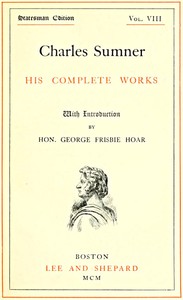
Charles Sumner: his complete works, volume 08 (of 20) — Key Ideas to Explore can be approached with a clearer sense of reading commitment from its source measurements: 117,707 words, 8 hr 32 min estimated reading time, and 17 detected text sections.
The text analysis averages about 22.9 words per sentence, while the detected sections provide another way to judge how the source is divided.
Project Gutenberg metadata also associates the work with “Slavery -- United States,” connecting these edition facts with the source record’s subject description.
Explore this collection
These alternatives are selected using recorded categories and estimated reading time.
About 440 minutes
Science Fiction Utopias
101,071 recorded words. 72 minutes difference from this book's estimate.
View Gutenberg source #70About 597 minutes
Science Fiction Utopias
137,213 recorded words. 85 minutes difference from this book's estimate.
View Gutenberg source #6304About 406 minutes
Science Fiction Utopias
93,252 recorded words. 106 minutes difference from this book's estimate.
View Gutenberg source #577Search stored excerpts and compare books → Choose by your preferences →
Choices use stored catalog measurements. Estimates vary with reading speed. A shared category is a catalog label, not a claim that two books have the same argument or literary quality.
Search reads excerpt text stored with this catalog and links to its associated Gutenberg record. The connection is stored in the site database; this tool does not recheck that every excerpt is word-for-word identical to that external record. Excerpt search does not cover every chapter and does not verify historical publication dates.
Catalog snapshot checked: 2026-09-25. Coverage: 92 public books, 92 available source excerpts.
Read the complete public-domain text at its original source.
Read on Project GutenbergVolume VIII of Charles Sumner's complete works opens with a Senate resolution on revising national statutes, but the most substantial excerpt—a speech on making Treasury notes a legal tender—unfolds as a detailed colonial history of paper money. Sumner traces bills of credit from Massachusetts in 1690 through other colonies, noting which were made legal tender and which were not. He cites specific acts, such as the 1751 Imperial Parliament prohibition, and observes that Parliament's need to forbid tender status 'attests the' common association between bills of credit and tender. This historical survey, occupying many pages, is not a speech about slavery or emancipation, despite the catalog's primary subject headings.
The Project Gutenberg record lists 'Slavery -- United States' and 'Speeches, addresses, etc., American' as the primary subjects. While Sumner was a noted abolitionist, the excerpts in this volume show a different emphasis. The legal tender speech, for instance, contains no mention of slavery; it is a densely researched account of colonial currency laws. Sumner discusses Massachusetts, Rhode Island, Connecticut, New York, Pennsylvania, Delaware, Maryland, Virginia, North Carolina, South Carolina, and Georgia, detailing each colony's issue of bills of credit and whether they were made a tender. The word 'slavery' does not appear in the excerpted text. This mismatch suggests that the catalog subject may be based on Sumner's overall reputation rather than the specific contents of this volume.
Sumner's speech on legal tender is not a philosophical or economic treatise but a chronological compilation of colonial precedents. He begins with Massachusetts in 1690, noting that bills were 'not made a tender' initially, then later issues were. He cites specific amounts: £150,000 in 1716, secured by mortgages. He quotes a historian who likened the currency to 'pretended values stamped on leather or paper.' The speech proceeds colony by colony, often noting the exact year of first issue and whether tender was required. For Virginia, Sumner points out that the term 'Treasury notes' first appeared in 1755, and that later acts treated 'bills of credit' and 'Treasury notes' as synonymous, even punishing forgery of either with death. This method—building an argument from legislative facts—characterizes Sumner's senatorial style.
The table of contents lists 17 sections, including speeches on fugitive slaves, emancipation, and the expulsion of senators. However, the only substantial excerpt provided is the legal tender speech. This speech, while not about slavery, does touch on a key issue of the Civil War era: the constitutionality of paper money. Sumner's deep dive into colonial history suggests he is arguing that legal tender laws have a long American pedigree. The excerpt cuts off mid-sentence, so the full argument is unknown. Readers should note that this volume likely contains a mix of topics, but the catalog's focus on slavery may overshadow other important content. The legal tender speech alone occupies many pages and represents a significant portion of the volume's word count.
Readers approaching this volume should be prepared for Sumner's characteristic reliance on historical evidence. His speeches are not oratorical flourishes but carefully documented briefs. The legal tender excerpt, with its colony-by-colony survey, exemplifies his method. While the catalog emphasizes slavery, the actual text may spend considerable time on constitutional and financial questions. To understand the volume's full range, consult the table of contents and sample other speeches. The excerpts here offer a narrow but revealing window into Sumner's legislative craft.
That rainy afternoon, Sumner’s dry colonial currency arguments blurred into the muffled drum of droplets on glass. His relentless citations made me crave looser, more personal prose. I set the volume aside and, almost without thinking, reached for A century of English essays — Text and Context. Sumner’s legal fervor felt oddly quiet next to their intimate musings. The rain never stopped, but the room softened.
A brief reflection can help important ideas stay with you longer.