About 70 minutes
The Man of Letters as a Man of Business — A Closer Reading
Fantasy Juvenile Worlds
15,920 recorded words. 3 minutes difference from this book's estimate.
View Gutenberg source #3388
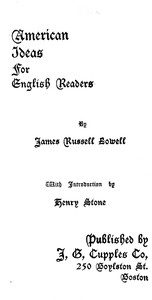
Before opening American ideas for English readers — Reading Notes, the edition data offers a quick orientation: 15,224 words, 1 hr 7 min estimated reading time, and 14 detected text sections.
The text analysis averages about 26.3 words per sentence, while the detected sections provide another way to judge how the source is divided.
Project Gutenberg metadata also associates the work with “Speeches, addresses, etc., American,” connecting these edition facts with the source record’s subject description.
Explore this collection
These alternatives are selected using recorded categories and estimated reading time.
About 70 minutes
Fantasy Juvenile Worlds
15,920 recorded words. 3 minutes difference from this book's estimate.
View Gutenberg source #3388About 58 minutes
Fantasy Juvenile Worlds
13,199 recorded words. 9 minutes difference from this book's estimate.
View Gutenberg source #1462About 97 minutes
Fantasy Juvenile Worlds
22,118 recorded words. 30 minutes difference from this book's estimate.
View Gutenberg source #3585Search stored excerpts and compare books → Choose by your preferences →
Choices use stored catalog measurements. Estimates vary with reading speed. A shared category is a catalog label, not a claim that two books have the same argument or literary quality.
Search reads excerpt text stored with this catalog and links to its associated Gutenberg record. The connection is stored in the site database; this tool does not recheck that every excerpt is word-for-word identical to that external record. Excerpt search does not cover every chapter and does not verify historical publication dates.
Catalog snapshot checked: 2026-09-25. Coverage: 92 public books, 92 available source excerpts.
Read the complete public-domain text at its original source.
Read on Project GutenbergJames Russell Lowell’s American Ideas for English Readers collects fourteen speeches and addresses delivered between 1884 and 1887, primarily before British institutions such as the Edinburgh Philosophical Institution, the London Chamber of Commerce, and the University of Cambridge. The volume, published in 1892 with an introduction by Henry Stone, presents Lowell in his role as a transatlantic cultural ambassador rather than as the poet of the Biglow Papers or the Commemoration Ode. Stone’s introduction frames the collection as a defense of Lowell’s patriotism against charges that his years abroad had diluted it—a claim the speeches themselves both complicate and confirm.
Lowell’s speaking style in these addresses is notably indirect. In his first appearance before an English audience after returning to England, he opens by invoking the lexicographer’s definition of “to answer for,” then immediately deflects: speakers on such occasions “are not always expected to allude except in distant and vague terms to the subject on which they are specially supposed to talk.” This self-deprecating maneuver recurs throughout. He describes himself as representing “the unity of English literature under whatever sky it may be produced” and “that growing friendliness of feeling … between the two branches of the British stock.” The audience’s cheers, noted in the text, suggest the strategy succeeded. Yet Lowell also undercuts his own authority, wishing his successor as American Minister could fill his place and speak “in a more eloquent and more emphatic manner.” The effect is a speaker who foregrounds his limitations even as he advances a diplomatic message.
Henry Stone’s introduction anticipates a central tension: what does it mean to be an American when speaking to English listeners? Stone distinguishes between a superficial Americanism of “out-talk, out-spend, out-bid, out-invent” and a deeper loyalty to “noble aim, humane, intelligent, peace-loving, more free, more self-re[…]” (the excerpt cuts off). Lowell himself, in the Edinburgh address, declares he returns from his native land “confirmed in my love of it and in my faith in it,” yet immediately balances this with gratitude for England’s welcome. He quotes the commander-in-chief’s maxim that every man must “put his own country first,” then adapts it: he loves his native country first, but puts England “at least next in my affection.” The speeches thus perform a double allegiance, never renouncing American identity while repeatedly affirming bonds of language, literature, and history with Britain.
The collection’s range of occasions—from a Royal Academy dinner to the unveiling of the Gray Memorial, from a Stratford fountain presentation to a Liverpool Philomathic Society meeting—shapes the content. The Stratford letter, written in Lowell’s absence, praises the fountain as a symbol for Shakespeare’s “broad river of speech” and for Queen Victoria’s “purity of character and example.” Here Lowell’s voice shifts from spoken to written, from self-deprecating to ceremonial. The volume also includes addresses on Robert Browning, international arbitration, and the dinner to American authors. These varied contexts mean the reader encounters not a single argument but a series of rhetorical adjustments: Lowell adapts his tone to each audience, sometimes humorous (“I desire to be brief, and therefore I efface myself”), sometimes solemn. The collection thus documents a diplomat’s craft as much as a writer’s ideas.
Readers approaching American Ideas for English Readers should attend to the interplay between Stone’s framing and Lowell’s actual words. The introduction asserts a consistent patriotism that the speeches render more conditional and situational. The volume rewards those who track how Lowell navigates his dual role as American citizen and English-speaking man of letters, and who note the gaps between the catalog subject “Speeches, addresses, etc., American” and the transnational, often conciliatory rhetoric on the page.
That rainy afternoon, Lowell's lectures about Anglo-American kinship felt like letters from a patient friend, his affection for shared language warming the gray light. Afterwards, idling, I stumbled upon his Sketches from Memory (From: "The Doliver Romance and Other Pieces: Tales and Sketches") — Inside the Classic, and found the same intimate voice, only softer, more private—a quiet turn from public speech to inward remembrance.
Use these questions to collect your thoughts before moving on.