About 23 minutes
Sketches from Memory (From: "The Doliver Romance and Other Pieces: Tales and Sketches") — Inside the Classic
Fantasy Juvenile Worlds
5,212 recorded words. 2 minutes difference from this book's estimate.
View Gutenberg source #9246
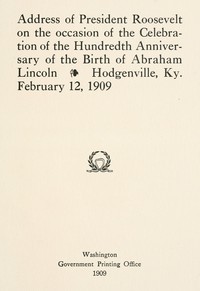
This digital edition of Address of President Roosevelt on the occasion of the celebration of the hundredth anniversary of the birth of Abraham Lincoln, Hodgenville, Ky., February 12, 1909 — Edition Insights is described by source-level measurements including 4,823 words, 21 min estimated reading time, and 3 detected text sections.
The text analysis averages about 28.0 words per sentence, while the detected sections provide another way to judge how the source is divided.
Project Gutenberg metadata also associates the work with “Speeches, addresses, etc.,” connecting these edition facts with the source record’s subject description.
Explore this collection
These alternatives are selected using recorded categories and estimated reading time.
About 23 minutes
Fantasy Juvenile Worlds
5,212 recorded words. 2 minutes difference from this book's estimate.
View Gutenberg source #9246About 33 minutes
Fantasy Juvenile Worlds
7,448 recorded words. 12 minutes difference from this book's estimate.
View Gutenberg source #3382About 58 minutes
Fantasy Juvenile Worlds
13,199 recorded words. 37 minutes difference from this book's estimate.
View Gutenberg source #1462Search stored excerpts and compare books → Choose by your preferences →
Choices use stored catalog measurements. Estimates vary with reading speed. A shared category is a catalog label, not a claim that two books have the same argument or literary quality.
Search reads excerpt text stored with this catalog and links to its associated Gutenberg record. The connection is stored in the site database; this tool does not recheck that every excerpt is word-for-word identical to that external record. Excerpt search does not cover every chapter and does not verify historical publication dates.
Catalog snapshot checked: 2026-09-25. Coverage: 92 public books, 92 available source excerpts.
Read the complete public-domain text at its original source.
Read on Project GutenbergTheodore Roosevelt's 1909 centennial address on Abraham Lincoln, delivered at the Lincoln birthplace in Hodgenville, Kentucky, opens with a striking declaration: Lincoln is "one of the two greatest Americans" and "one of the two or three greatest men of the nineteenth century." Roosevelt immediately establishes a tone of solemn reverence, using parallel structure and biblical cadence to elevate Lincoln's life from "rail splitter" to national leader. The speech's language is deliberately archaic and rhythmic, with phrases like "purified as by fire, born anew to a loftier life" echoing the King James Bible. This opening section sets up a contrast between Lincoln's humble origins—"ungainly youth in the dire poverty of the poorest of the frontier folk"—and his eventual role as a world-historical figure.
Roosevelt's address is built on a series of antithetical pairs that create a pulsing, almost poetic rhythm. He repeatedly contrasts Lincoln's suffering with his strength: "He grew to know greatness, but never ease. Success came to him, but never happiness." This pattern of negation—"but never"—reinforces the idea of Lincoln as a tragic hero. The speech also employs anaphora, as in "Disaster saddened but never dismayed him" and "Unbroken by hatred, unshaken by scorn." These rhetorical devices give the address a liturgical quality, as if Roosevelt is delivering a secular sermon. The language is formal and elevated, with few colloquialisms, reflecting the occasion's gravity. Roosevelt's own voice merges with the subject, as he adopts Lincoln's own measured, deliberate style.
Roosevelt emphasizes Lincoln's physical appearance and suffering, using vivid bodily imagery. He describes "the furrows deepened on his brow," "his gaunt shoulders were bowed," and "his steel thews never faltered." This focus on Lincoln's body—his "ungainly youth," his "weary and painful labor"—grounds the abstract ideals of leadership in tangible, human terms. The speech repeatedly returns to the cost of leadership: "to pour out like water the life-blood of the young men, and to feel in his every fiber the sorrow of the women." Roosevelt's language here is visceral, almost violent, emphasizing the physical and emotional toll of the Civil War. This bodily focus contrasts with the more abstract praise of Lincoln's character, creating a tension between the man and his myth.
The address is relatively short—around 4,800 words—and divided into three sections, though the excerpts show only the opening. The pace is deliberate, with long, periodic sentences that build to a climax. Roosevelt uses a series of parallel clauses to create a cumulative effect, as in the opening paragraph's list of Lincoln's attributes: "This rail splitter, this boy... lived to lead his people..." The speech's rhythm is slow and stately, matching the solemnity of the centennial occasion. There are no abrupt shifts in tone; instead, Roosevelt maintains a consistent register of high seriousness. The address's structure mirrors its content: it is a carefully crafted monument in prose, designed to honor Lincoln's legacy through its own formal beauty.
Readers should attend to how Roosevelt's address functions as both a historical document and a piece of political rhetoric. The speech reveals as much about Roosevelt's own values—his emphasis on struggle, duty, and sacrifice—as it does about Lincoln. Pay attention to the way Roosevelt uses biblical language and rhythmic repetition to create a sense of inevitability and moral weight. The address is a performance of reverence, and its power lies in its formal, almost liturgical structure.
Reading Roosevelt’s Lincoln address, I felt that old ache of watching a plain man become a monument. It made me think of how certain voices—Lincoln’s, or even Roosevelt’s—seem rooted in a specific soil, yet speak to something eternal. That quiet thread of place and meaning lingers in American Literary Centers (from Literature and Life) — A Closer Reading, and I found myself drifting there, half-remembering why we return to such words at all.
Create a short personal record of your experience with this book.