
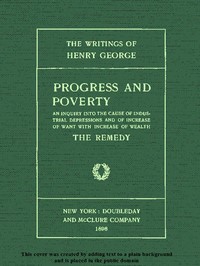
Progress and Poverty, Volumes I and II by Henry George
Let's be honest: a two-volume economic treatise from the 1800s doesn't sound like a page-turner. But Progress and Poverty defies expectations. Henry George wasn't a stuffy academic; he was a self-educated man who saw the stark contrast between America's industrial boom and the crushing poverty in its shadows. This book is his attempt to solve that puzzle.
The Story
There isn't a plot in the traditional sense. Instead, George lays out a logical argument. He starts with a simple observation: technological and social progress should make everyone's life better. But in reality, it often drives up rents and land prices, making life harder for workers and business owners who don't own property. He argues that this isn't an accident but a systemic flaw. The core of his idea is that the value of land increases because of the community around it—the roads, schools, and businesses—not because of what the landowner does. He proposes a bold solution: replace most taxes with a single tax on the value of land itself. This, he believed, would unlock prosperity for everyone.
Why You Should Read It
You should read this not to become an expert on 19th-century tax policy, but because George frames a fundamental question about fairness in a way that's incredibly clear and passionate. His writing has a moral urgency that cuts through complex theory. He makes you see land and rent in a whole new light. Even if his 'single tax' seems unrealistic today, the core problem he identifies—how society shares the value it creates together—feels more relevant than ever in our age of housing crises and vast inequality. It's a book that changes how you look at your city, your neighborhood, and the economy.
Final Verdict
This is for the curious reader who likes big ideas. Perfect for anyone interested in economic history, political philosophy, or urban planning. It's also great for people who enjoy a strong, well-argued opinion, even if they might disagree with it. If you've ever felt that the way we run our economy is unfair but couldn't quite put your finger on why, Henry George offers a provocative and compelling explanation. Just be prepared—it might change your mind about a lot of things.
No rights are reserved for this publication. You do not need permission to reproduce this work.
Jessica Wilson
9 months agoHaving explored several resources on this, I find that the objective evaluation of the pros and cons is very refreshing. I'll be citing this in my upcoming project.
Jessica Jackson
2 years agoUnlike many other resources I've purchased before, the author clearly has a deep mastery of the subject matter. Well worth the time invested in reading it.
Sandra Clark
1 year agoHonestly, it manages to explain difficult concepts in plain English. I will read more from this author.
Elizabeth Jackson
1 year agoVery interesting perspective.








John Smith
2 years agoGiven the current trends in this field, the author’s unique perspective adds a fresh layer to the discussion. Simple, effective, and authoritative – what else could you ask for?