
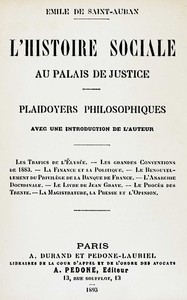
L'histoire sociale au Palais de justice. Plaidoyers philosophiques by Saint-Auban
Let's set the scene: France in the late 19th and early 20th centuries. The courtrooms are grand, formal, and often blind to the struggles of the poor. Into this world steps Émile de Saint-Auban, a lawyer with a different mission. L'histoire sociale au Palais de justice isn't a novel; it's a collection of his actual courtroom speeches, or "pleadings." But these aren't dry legal documents. Saint-Auban used his time before the judge to do something radical. For each client—often ordinary people crushed by debt, injustice, or hardship—he built a case that went beyond the individual. He turned the defense of a single person into an indictment of the social conditions that created the problem.
The Story
The "plot" is the unfolding of his career through these speeches. We don't follow a fictional character, but we follow Saint-Auban's evolving argument against social indifference. Each chapter is a case: a worker wronged, a family in ruin, an unfair law applied. He uses stories, data, and moral philosophy right there in the legal arena. The drama is in his audacity. He's playing by the court's rules but trying to rewrite the game, using the language of the law to challenge the law itself. It's the story of a man trying to plant the seeds of social change in the most resistant soil imaginable.
Why You Should Read It
This book surprised me. I expected dusty history, but found a voice that feels urgent. Saint-Auban's passion leaps off the page. You can feel his frustration and his deep empathy. What gripped me most was the sheer nerve of his strategy. In a place dedicated to precedent and procedure, he argued for humanity and systemic change. It makes you think about the power of a well-chosen word in the right room. It's also a stark reminder that debates about justice, inequality, and whether the law serves the people aren't new—they've been raging in quiet corners for centuries. Reading this is like finding a crack of light in a historical wall, showing a fight we're still having today.
Final Verdict
This is a niche book, but a powerful one. It's perfect for history buffs who want to see beyond kings and battles to the ideas that moved society. It's great for anyone in law or social work who needs a dose of historical inspiration. Most of all, it's for readers who love finding real-life characters who dared to speak truth to power in clever, unconventional ways. If you enjoy biographies of unsung reformers or stories about the power of rhetoric, you'll find Saint-Auban's philosophical pleas absolutely captivating. Just be ready—it might make you look at modern courtrooms and news headlines a little differently.
This masterpiece is free from copyright limitations. You do not need permission to reproduce this work.
Daniel White
1 year agoTo be perfectly clear, the plot twists are genuinely surprising. I learned so much from this.
Michelle Young
1 year agoSimply put, the content flows smoothly from one chapter to the next. Exceeded all my expectations.
Michael King
1 year agoAs someone who reads a lot, the clarity of the writing makes this accessible. A valuable addition to my collection.








Andrew Flores
2 years agoI was skeptical at first, but it challenges the reader's perspective in an intellectual way. Exactly what I needed.